

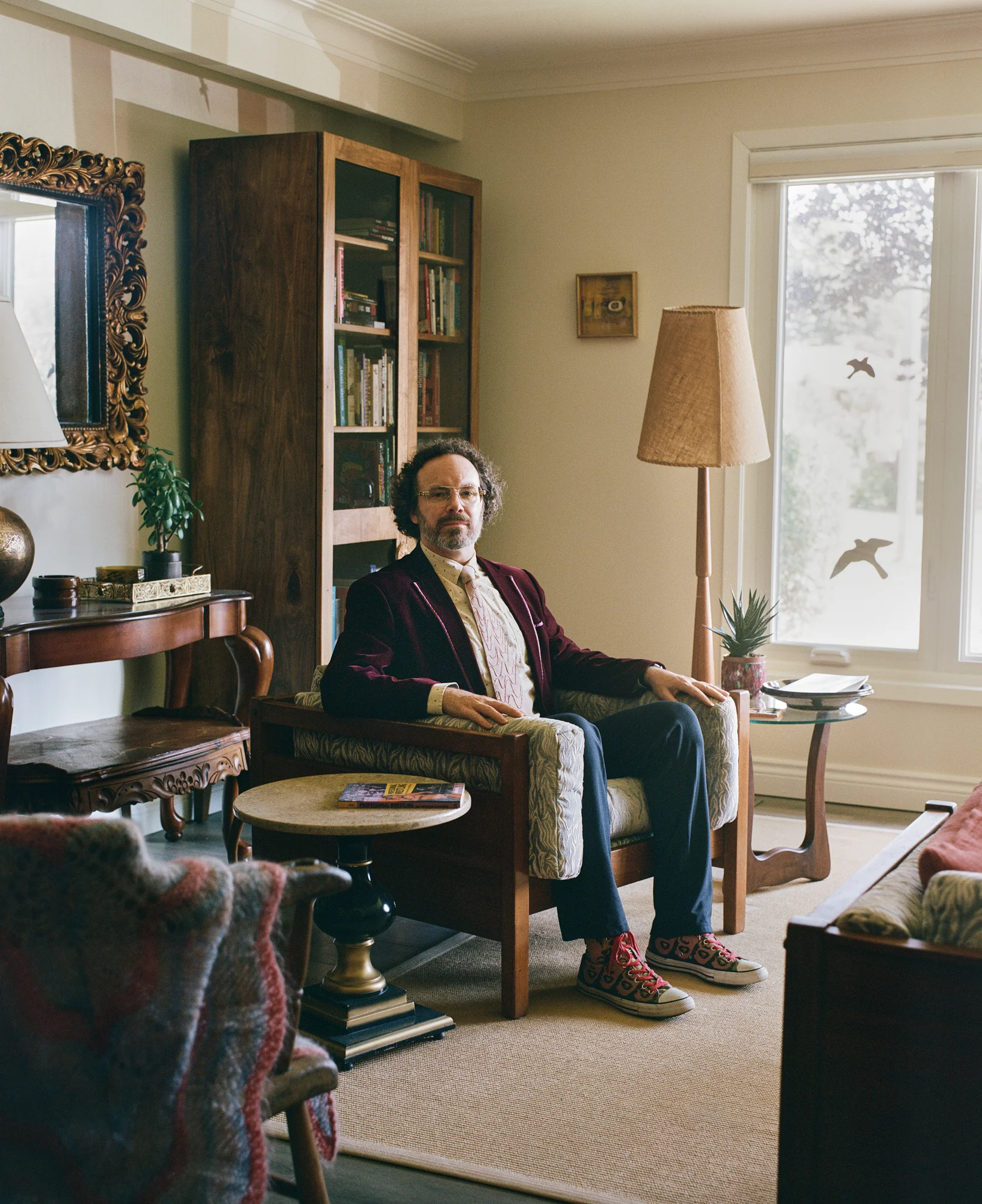
Photograph by Gabriel Hutchinson
Why This English Professor Stepped into the Wrestling Ring
For Daniel Scott Tysdal, the experience opened up a new way to think about storytelling – and teaching
Most English professors do not spend their weekends getting body-slammed. But then, most are not Daniel Scott Tysdal.
On Thursday nights, the U of T Scarborough creative writing professor swaps the classroom for a wrestling ring, training alongside athletes sometimes half his age at a Toronto studio. To some, it might seem like an unlikely pursuit. Tysdal sees it differently. “Professional wrestling is all about storytelling,” he says.
Tysdal has long been drawn to stories that refuse to stay neatly inside traditional boundaries. His poetry has borrowed from advertising, poker and internet culture. His short films have experimented with abstract visual forms. His fiction ranges from literary short stories to horror. Across genres and media, he has pursued the same question: What happens when a story demands a different way of being told?
It’s an approach that now influences his teaching, but it began long before he entered a classroom.
But his students began changing his mind. In office hours, he spoke about his own circuitous path through university. It had taken him eight years to complete a four-year undergraduate degree. He left school twice, and, at one point, was placed on academic probation. “Students can put so much pressure on themselves,” he says. “I wanted them to know there’s no single right path and that there are people here to help.”
A spirit of experimentation reaches back to his childhood on a grain farm south of Moose Jaw, Saskatchewan. Outside was the prairie. Endless skies and old barns gave a child room to disappear into his imagination. His parents were avid readers whose shelves overflowed with books. They also loved movies and television and, in the early 1980s, installed one of those enormous satellite dishes. All at once, he had access to MTV, concerts, movies and Nickelodeon.
He imagined himself making movies, writing stories and exploring the world beyond the grain fields. Encouraged by parents who recognized he was “more of an artist” than a farmhand, Tysdal had the freedom to follow his curiosity, though finding his voice as a writer took years. Looking back to his late teens and 20s, he says he was writing the poems he thought he was supposed to write instead of the ones that only he could.
Then he hit on an idea. Frustrated with one of his poems, he imagined a reader interrupting it, criticizing every cliché and weak line. He inserted himself into the poem to argue back. Suddenly, it became a conversation – messy, self-aware and a little strange. Almost as an afterthought, he submitted it to Grain magazine, which accepted it for publication in 2001 while he was still an undergrad at the University of Regina.
That moment reshaped his career. “When that poem was accepted, it was like receiving permission to go down that road,” he says. Instead of asking what a poem should look like, Tysdal began asking what form a particular story required. In his first collection, Predicting the Next Big Advertising Breakthrough Using a Potentially Dangerous Method, lines of poetry collide with the language of advertising and popular culture. It became the first of many projects that blurred boundaries between genres.
An instinct to challenge conventions wasn’t simply an artistic choice. It also grew from a lifetime of living with mental illness. Tysdal traces his earliest memories of it to age five. As a child, writing offered a way to understand feelings that resisted easy explanation, or simply a way to escape them. “I wasn’t sitting there thinking, ‘I’m going to write a good story,’” he says. “I was trying to understand what I was feeling.”
For years, he kept that part of his life largely hidden. As a young professor at U of T Scarborough, he worried students might think less of him if they knew he struggled with mental illness. He feared colleagues might question his abilities.
Most Popular

Sleep Is Essential. So Why Do We Need So Little?
The answer may help explain how humans came to thrive Read More

How Does Alzheimer’s Begin?
We can detect Alzheimer’s years before symptoms appear. Now, researchers are racing to understand what sets the disease in motion Read More

Can We Solve the Mystery of Consciousness?
For almost 150 years, we’ve struggled to explain conscious experience. One U of T philosopher thinks an answer may be within reach Read More

In 2014, Tysdal was invited to give a TEDx Talk, where he shared a story about a close friend who had died by suicide and the conversations they never had about mental illness. Standing backstage before the talk, he agonized about going through with it. But he walked on stage and publicly shared his experience for the first time. Rather than changing the way people saw him, the talk opened conversations with students, colleagues and strangers who recognized parts of themselves in his story.
That response gradually transformed his classroom. Today, he is open to his students about his struggles with mental health. And he fosters a diverse reading list. Alongside canonical texts, Tysdal introduces students to contemporary poets, including queer writers, racialized writers and writers living with mental illness. Students aren’t asked simply to write essays. They read poetry and comics, attend wrestling shows, and, for final projects, can choose whether to respond through criticism, fiction, nonfiction or poetry.
As one student, Essence Mitchell, puts it, Tysdal’s courses give students “both academic and creative ways to approach” their work. “He brings everything to life by creating a classroom where ideas can be tested through experience as well as on the page.”
That curiosity to creatively experiment eventually led him somewhere few would have expected: a wrestling ring. At the start of the pandemic, Tysdal and his wife rediscovered professional wrestling. What began as a lark became a shared obsession – and then research. If he was going to write about wrestling, he thought, he should step into the ring himself. In 2022, he signed up for a class.
He was also struggling once again with his mental health and questioning what came next in his life. Walking to that first class, he was terrified. But in the ring, something unexpected happened. He found camaraderie. He found people cheering him on as he learned basic moves. He found a demanding art form built on trust.
The first thing wrestlers learn, he says, is how to fall. Before headlocks and characters come drills that teach the body how to hit the mat safely. The lesson is practical, but he also saw it as a metaphor. Wrestling did not “fix” him, he is careful to note. But it helped him remember that he was resilient and still able to learn something new.
Professional wrestling, he says, is a deeply theatrical art form. It has characters, arcs, rivalries, betrayals, reversals and redemption. There is also something known in wrestling circles as kayfabe – the suspension of disbelief that allows audiences to be swept into a match even while knowing it is a performance.
Eventually, wrestling found a way into his classroom. In 2024, Tysdal launched a UTSC course focused on the storytelling side of professional wrestling. Students examine it both as an art form and as a way to explore class, gender, race, sexuality, politics and narrative. They analyze matches, engage with critical theory and poetry, and complete projects that include essays, creative work and developing their own wrestling persona. The class has been a hit with students, who organized a live wrestling event on campus at semester’s end.
“It felt like I was being let in on this secret,” says Rekha Samlal, a fourth-year English and creative writing student. “Having a class like this, where you have the opportunity to live your lectures, brings a different level of engagement with the course material.”
Tysdal is still chasing unconventional stories. He is working on a horror novel, a slasher screenplay and a creative nonfiction book about his years training as a wrestler. He hopes to capture the joy, artistry and storytelling of professional wrestling rather than revisit its darker myths.
“I’ve always had this eagerness to explore and a willingness to compile voices and images and texts that maybe seem disparate but can be woven together to tell a unique story,” he says. “Embracing those unexpected connections has shaped my career, and I don’t see that changing anytime soon.”
Most Popular
How Does Alzheimer’s Begin?
We can detect Alzheimer’s years before symptoms appear. Now, researchers are racing to understand what sets the disease in motion Read More
Can We Solve the Mystery of Consciousness?
For almost 150 years, we’ve struggled to explain conscious experience. One U of T philosopher thinks an answer may be within reach Read More
Sleep Is Essential. So Why Do We Need So Little?
The answer may help explain how humans came to thrive Read More
No Responses to “ Why This English Professor Stepped into the Wrestling Ring ”
It takes a special person to put himself out there like this, especially at U of T – Canada’s top university. It encourages students to open up about personal issues they may be afraid to share. They can see that a professor they respect has faced his own challenges and still achieved success.