Culture & Society
Three Indigenous Artists Who are Challenging the Way We See
A closer look at works from U of T’s growing collection of contemporary Indigenous art – and the ideas they bring into view Read More
U of T’s art collection includes pieces by some of the most celebrated Indigenous artists working in Canada today. Many of these artworks can be seen in galleries and public spaces across the university, while others support teaching, research and future exhibitions. The collection spans photography, beadwork, sculpture, painting, installation and Inuit art. Some works honour family and language. Others confront stereotypes, revisit history or invite viewers to reconsider their relationship to the land on which the university operates.
Guided by the Truth and Reconciliation Commission’s Calls to Action, the university has significantly expanded this collection. At Hart House, Rebecca Belmore and Osvaldo Yero’s sculpture waabidiziiyan doopwining (“to see yourself at the table”) has become a focal point. At Simcoe Hall, works by contemporary Indigenous artists now occupy spaces once exclusively held by traditional portraits of university leaders.
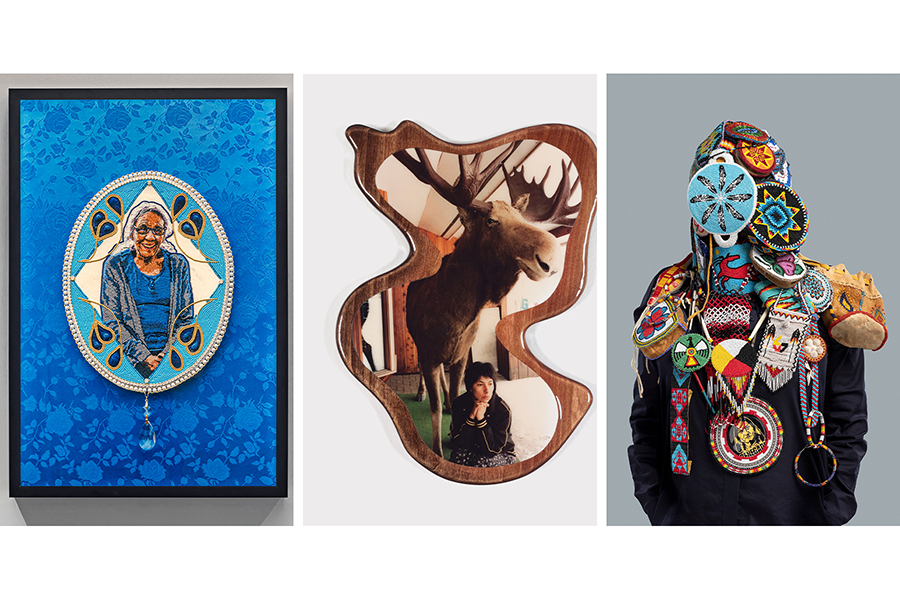
For this feature, we asked curators at each campus to select a work they found especially compelling. The three pieces featured here differ in style and subject matter, and each offers a distinct perspective on Indigenous experience.
Most Popular

Sleep Is Essential. So Why Do We Need So Little?
The answer may help explain how humans came to thrive Read More

Can We Solve the Mystery of Consciousness?
For almost 150 years, we’ve struggled to explain conscious experience. One U of T philosopher thinks an answer may be within reach Read More

How Does Alzheimer’s Begin?
We can detect Alzheimer’s years before symptoms appear. Now, researchers are racing to understand what sets the disease in motion Read More

Setsuné (2023)
From the Doris Mcarthy Gallery permanent collection. The artwork is displayed in Indigenous House at UTSC.
Catherine Blackburn (Dene/European, English River First Nation) is a multidisciplinary artist and jeweller whose work combines traditional beadwork with contemporary art and fashion. Inspired by personal and collective history, she explores Indigenous sovereignty, representation and the legacy of colonialism in Canada.
- The portrait depicts Blackburn’s grandmother, Christine George, whose skill in beadwork and hide tanning inspired the artist from childhood. Blackburn has described watching her grandmother transform animal hides into leather of a deep golden brown before decorating them with intricate beadwork.
- Thousands of beads create subtle shifts in light, colour and texture. Blackburn frequently uses mixed media and fashion to create a dialogue between historical art forms and their contemporary interpretations.
- This image was originally part of a larger sculptural work called Ancestor Dreamin’. In this version, light brings Blackburn’s grandmother to the foreground, emphasizing her presence and influence. In many Indigenous teachings, Elders play a vital role in preserving knowledge, language and cultural traditions.
Curators Julia Abraham and Caitlyn Bird explain why they chose this work
Setsuné embodies the spirit of Indigenous House and the stories that will be shared within its walls. The work honours Elders and reflects the sense of Indigenous House as a place where Indigenous students, staff and community members can come together to feel supported, connected and nourished.
Most Popular
Sleep Is Essential. So Why Do We Need So Little?
The answer may help explain how humans came to thrive Read More
How Does Alzheimer’s Begin?
We can detect Alzheimer’s years before symptoms appear. Now, researchers are racing to understand what sets the disease in motion Read More
Can We Solve the Mystery of Consciousness?
For almost 150 years, we’ve struggled to explain conscious experience. One U of T philosopher thinks an answer may be within reach Read More

Headdress – Dana (2019)
This artwork is displayed at Simcoe Hall as part of the exhibition, acknowledging the land.
Dana Claxton (Wood Mountain Lakota First Nation) is known for large-scale photographs, films, performances and installations that honour the richness and vitality of Indigenous cultures while reimagining conventional portraiture. Headdress – Dana is part of a series of portraits celebrating Indigenous community, identity and belonging.
- Traditional portraits often emphasize the uniqueness of an individual sitter. Here, Claxton’s face is hidden by objects that connect her to family, community, history and culture – a deliberate inversion of the portrait convention.
- The headdress is not traditional ceremonial regalia. Claxton assembled it from beadwork and keepsakes that represent family, friendship, memory and cultural belongings.
- The beadwork pieces come from Claxton’s personal collection and were created by artists from different Indigenous communities. Together, they form a visual record of kinship and cultural knowledge.
- The Medicine Wheel, identified by its four colours – yellow, black, red and white – is a widely recognized Indigenous symbol representing interconnected relationships among people, the natural world and the four directions.
- The Thunderbird (to the immediate left of the Medicine Wheel) is an important spiritual figure in many Indigenous traditions. Claxton incorporates the symbol among the many belongings that help construct this portrait.
- Unlike a conventional photograph, Headdress – Dana is presented in a glowing LED “firebox” (Claxton’s term for lightbox), intensifying its colours and emphasizing the work’s presence within the space.
Curators Barbara Fischer and Alex King explain why they chose this work
Dana Claxton is one of the most influential Indigenous artists working in Canada today. Headdress – Dana brings together many of the themes that have shaped the Art Museum’s recent collecting efforts: Indigenous presence, self-representation and the power of art to question familiar ways of understanding history and place. It is also a visually striking work that rewards close looking.
Most Popular
How Does Alzheimer’s Begin?
We can detect Alzheimer’s years before symptoms appear. Now, researchers are racing to understand what sets the disease in motion Read More
Sleep Is Essential. So Why Do We Need So Little?
The answer may help explain how humans came to thrive Read More
Can We Solve the Mystery of Consciousness?
For almost 150 years, we’ve struggled to explain conscious experience. One U of T philosopher thinks an answer may be within reach Read More

Five Sisters (1997)
From the Blackwood Gallery’s permanent art collection at UTM. The artwork is not on display but supports teaching , research and external exhibitions.
Rebecca Belmore (Anishinaabekwe, Lac Seul First Nation) is one of Canada’s most influential contemporary artists. Five Sisters consists of five photographs depicting Indigenous women in everyday settings around Sioux Lookout, Ontario. In this image, one of the series’ five “sisters” sits before a taxidermied moose.
- Belmore appears in all five photographs. Rather than portraying herself, she steps into the lives of five different women – blurring the line between one person’s experience and that of a wider community while emphasizing Indigenous perspectives and agency.
- The taxidermied moose was displayed at a nearby gas station as a tourist attraction. By positioning herself in front of it, Belmore shifts attention away from spectacle and toward questions of representation and who gets to be looked at.
- The photograph is mounted on a varnished wooden plaque resembling the souvenir art often found in homes and tourist shops. Belmore borrows this format while challenging the stereotypes these objects have historically promoted.
- The women in Five Sisters appear in bars, along roadsides, near tourist attractions and in other ordinary places, defining Indigenous presence on their own terms.
Curator Jacqui Usiskin explains why she chose this work
Rebecca Belmore’s Five Sisters has become one of the defining works in the Blackwood Gallery’s collection. Its undulating wooden contours draw viewers in, while the woman’s calm, resolute presence suggests both resilience and quiet defiance. Seated before a taxidermied moose, she confronts a colonial history, rejecting the treatment of land, animals and Indigenous peoples as things to be possessed or exploited. We are proud to share this work with the wider university community.
Most Popular
How Does Alzheimer’s Begin?
We can detect Alzheimer’s years before symptoms appear. Now, researchers are racing to understand what sets the disease in motion Read More
Can We Solve the Mystery of Consciousness?
For almost 150 years, we’ve struggled to explain conscious experience. One U of T philosopher thinks an answer may be within reach Read More
Sleep Is Essential. So Why Do We Need So Little?
The answer may help explain how humans came to thrive Read More