


If you have diabetes, there are markers doctors can use to track your condition. With diseases of the brain, it’s far more difficult. While there are general symptoms – dizziness, fogginess and exhaustion – it’s not clear how they relate to brain function. Is the patient improving? Getting worse? Clinicians often can’t say.
Cove Neurosciences aims to close this gap. The Toronto-based company, co-founded by Nardin Samuel (PhD 2016, MD 2018) and neurosurgery resident Irene Harmsen (MD 2023), is developing a technology that promises something long missing from brain care: an objective way to measure brain function and recovery. Their innovation, CoveConnect, generates metrics to assess a patient’s status and progress.
The platform has been validated in pilot studies, described in peer-reviewed papers and supported by more than $700,000 in funding from industry, academic and early-stage innovation sources.
For Samuel, who has a deep interest in brain health, the problem is all too familiar. After a brain injury, like a concussion, standard medical imaging often reveals little. “MRI scans are normal. CT scans are normal,” she says. Clinicians are left relying largely on patients’ own descriptions of how they feel – subjective reports that can vary widely.
CoveConnect analyzes signals from the brain using artificial intelligence to identify patterns that could serve as biomarkers – measurable indicators of what is happening inside the body. The goal is to do for brain health what blood pressure readings do for hypertension and glucose tests do for diabetes: provide a clear, measurable result that can guide care.
“This tool can enable us to couple clinical assessments, which may be very subjective, with something that’s objective,” says Samuel.
In its current form, CoveConnect draws on electroencephalography, or EEG, which records electrical activity in the brain using electrodes placed on the scalp. EEG machines are widely available and portable – some can even be used at home – making it possible to take repeated measurements over time. In future, the team hopes also to use data from magnetoencephalography, or MEG, which measures the magnetic fields generated by electrical currents in the brain.
What matters most, Samuel explains, is not activity in a single brain region but how different areas communicate with each other. “There are multiple hubs in the brain that are involved in the way we think, act and talk,” she says. By integrating that electrical information, CoveConnect produces mathematical measures of functional connectivity – a window into how well the brain’s networks are operating.

The potential applications are broad. CoveConnect has been piloted in studies of depression, stroke, autism, ADHD and Alzheimer’s disease. “This tool is disease-agnostic,” Samuel says.
Alzheimer’s, in particular, offers an urgent use case. As new drugs emerge, clinicians and researchers need to determine if they are actually helping patients – or at least slowing the rate of decline. “Being able to measure brain function objectively,” says Samuel, “can help us better understand the real-world impact of these drugs.” She envisions patients receiving a baseline assessment, then multiple follow-ups as they use a new drug or intervention, with treatment decisions guided by each patient’s biomarkers.
CoveConnect can already distinguish between people with Alzheimer’s and those without the disease. Samuel hopes the technology will soon become more precise – able to differentiate between mild and moderate disease. Early detection matters, she says, because interventions are more effective before significant decline occurs. “I want to see if we can do better to capture these people with early cognitive impairment.” Someday, she adds, the technology might even help predict Alzheimer’s before symptoms appear.
For Samuel, it’s the long run that matters most. “This is transformational work,” she says. “It is laying the foundation for future breakthroughs.”
Most Popular

She Designed a Water-Purifying Molecule at 17
Now a U of T student, Diana Virgovicova is using AI to help tackle global water pollution Read More

A New Way to Protect Your Teeth
A U of T alum’s dental chew aims to tackle one of the world’s most widespread – and overlooked – health problems Read More
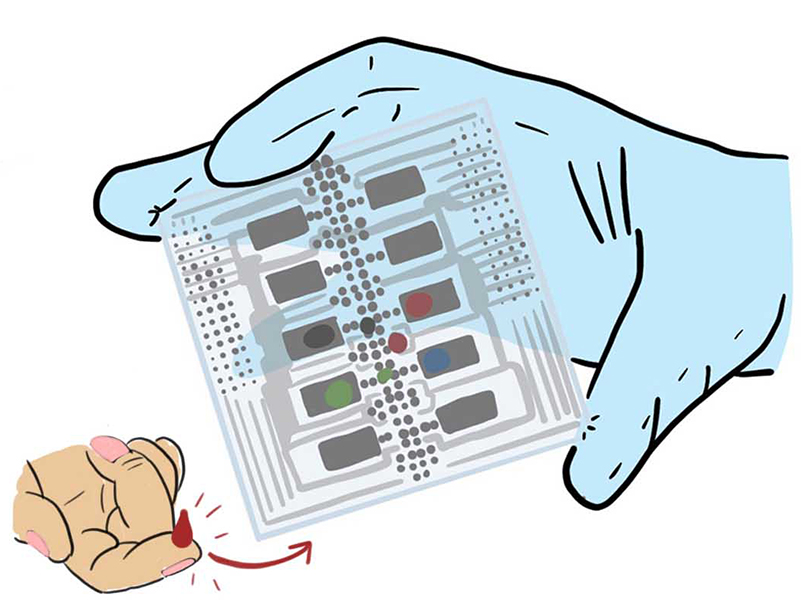
A New Way to Monitor Heart Patients
“Lab on a chip” technology will reduce travel expenses and improve care for those living in remote communities Read More
No Responses to “ AI Gives Doctors a New Way to Track Brain Health ”
Very cool article! Congratulations to the amazing scientists who spearheaded the platform!
This article is fascinating. The prospect of detecting neurological diseases earlier by combining scientific research, drug development and AI is especially promising. Such collaboration could help identify and treat many brain conditions that currently go undiagnosed, ultimately improving our understanding of brain function and how to care for it.
At the ADD Centres in Mississauga and Toronto, we have used EEG for more than 30 years to identify patterns and then train the brain using neurofeedback to improve how it functions. Applying AI to analyze these patterns could make the process more efficient, but it must be done carefully. Systems need to filter out irrelevant “noise” in the data without accidentally removing unusual but important signals — such as those linked to conditions like epilepsy.