

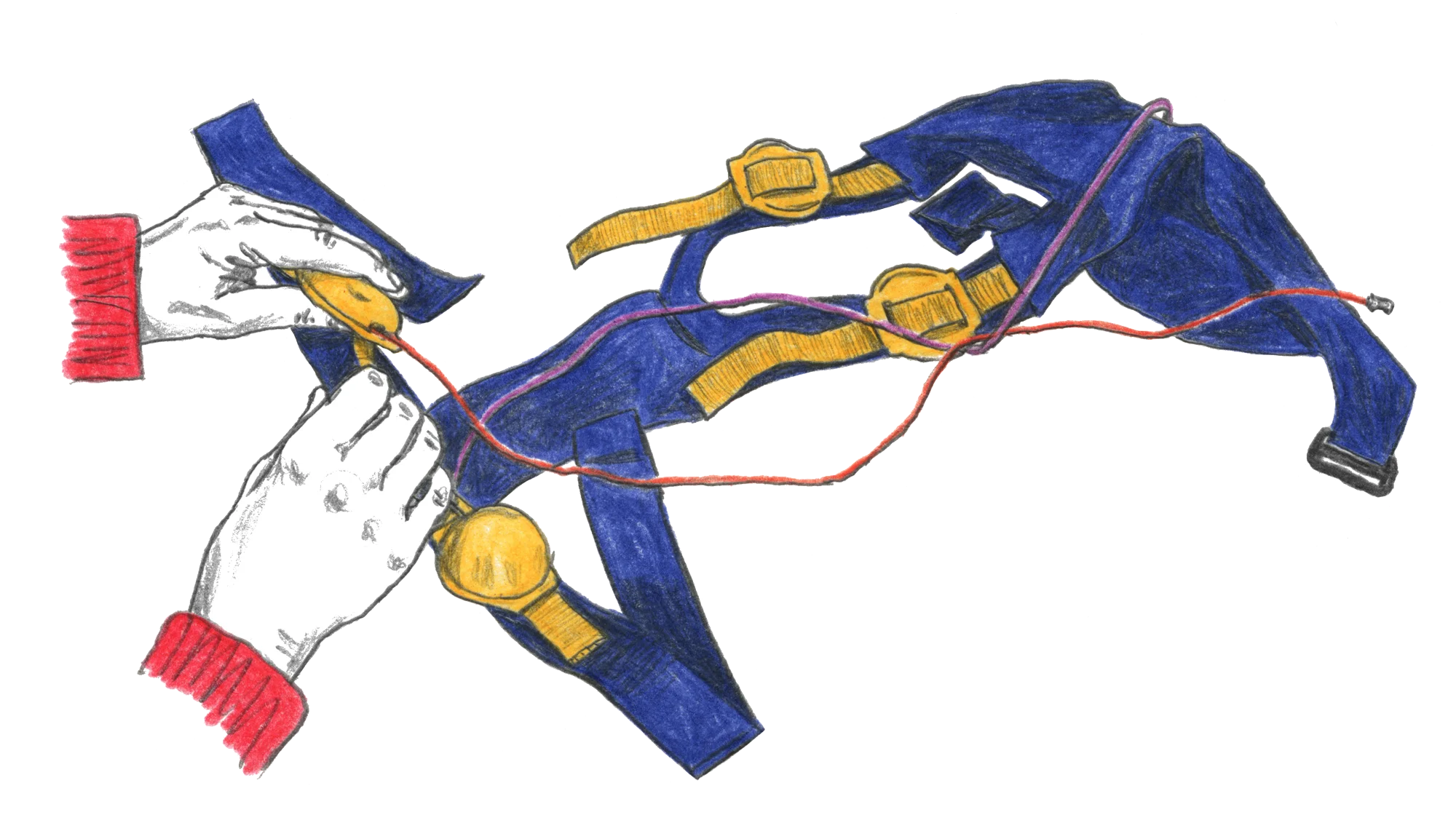
When Karolina Pakėnaitė attempts to climb Mount Everest in 2027, she hopes to become the first DeafBlind person to reach the summit. Helping guide her ascent will be the Haptic Harness, a wearable communication system co-created by Leon Lu, an assistant professor at U of T Mississauga.
How it began
Originally developed out of Lu’s earlier research into helping blind and low-vision musicians communicate with instructors, the harness uses haptic technology – vibrations like those from a cellphone – to replace spoken instructions when hearing and sight aren’t enough. The project was born after Lu met Pakėnaitė at an accessibility conference.
“Speaking” through touch
The Haptic Harness uses four small motors – one on each shoulder and two above the waist – to send directional signals through vibration. Different patterns tell Pakėnaitė when to move left, right, upward or downward, while the duration and pattern of the vibrations can communicate more complex instructions.
Extreme environments
On Everest, heavy masks, fierce winds and distance can make verbal communication difficult even for sighted and hearing climbers. With the Haptic Harness, Pakėnaitė’s guides will use a handheld remote to transmit signals directly to the vest, creating a reliable line of communication.
Beyond the mountain
Although the harness has been customized for Pakėnaitė’s historic climb next spring, Lu believes it could have many other uses. Working with collaborators in Germany, China and Canada, he designed the system to function in harsh conditions – but its potential extends far beyond Everest. “It could definitely help in any scenario where voice or visual communication is not practical,” he says.
Most Popular

She Designed a Water-Purifying Molecule at 17
Now a U of T student, Diana Virgovicova is using AI to help tackle global water pollution Read More

10 Vows for a Stronger Marriage
A U of T grad student wrote her wedding vows based on research into what makes a relationship last Read More

How Does Alzheimer’s Begin?
We can detect Alzheimer’s years before symptoms appear. Now, researchers are racing to understand what sets the disease in motion Read More
